

Everyone knows about the NFL Combine in Indianapolis. It is the place where players run around in spandex while millions of people watch them run in a straight line. It is a sterile lab where speed, strength, and vertical leaps are measured down to the decimal point. It is biomechanics at its finest.
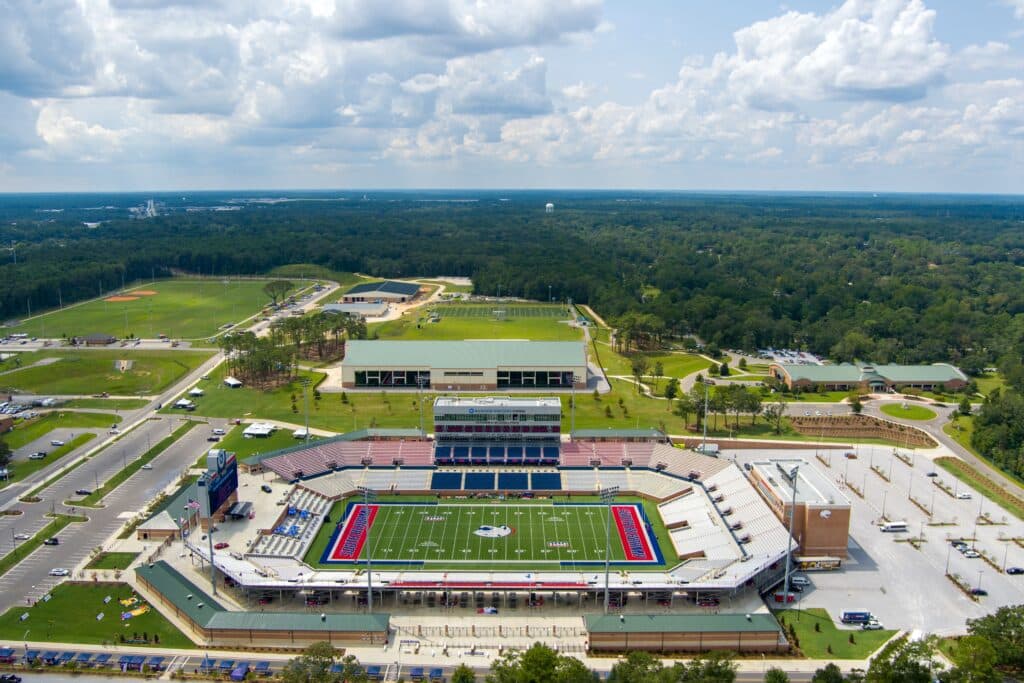
But if you ask the people actually making the decisions in NFL front offices, they will tell you the real test happens weeks earlier. It happens in the humidity of Mobile, Alabama.
The Senior Bowl is often mistaken for a physical all-star game. It looks like one on TV. But in reality, it is a psychological stress test. It is a calculated experiment designed to see if a player can unlearn four years of college habits and download a professional operating system in less than 48 hours.
We call it the “Installation Phase,” but the players just call it “drinking from a firehose.”
For the 2026 Senior Bowl, the pressure cooker is hotter than usual. The coaching staffs from the New Orleans Saints and the Philadelphia Eagles are running the show, and they are bringing a level of complexity that is going to break some brains. Plus, there is some new tech involved that reads a player’s personality based on how they talk.
Let’s get under the hood of the invisible combine.
The Setup: Why 2026 is Different
The difficulty of the Senior Bowl changes every year based on who is coaching. Some years you get staffs that run simple stuff just to get through the week. This is not one of those years.
The American Team is being coached by the New Orleans Saints staff, led by Associate Head Coach Joel Thomas. The Saints didn’t just send a skeleton crew. They sent seven coaches. That is massive. They are treating this like a business trip because they want to see if these kids can handle their offense.
And the Saints’ offense is not simple. It is rooted in the West Coast Offense discipline. That means precise timing, horizontal spacing, and verbiage that sounds like a foreign language to most college kids.
On the other side, you have the National Team led by the Philadelphia Eagles’ Clint Hurtt. He comes from that defensive tree where fronts are hybrids and linebackers have to know gap integrity that changes based on motion.
The coaches are under pressure too. This is the “Coach Up” format, meaning assistant coaches are elevated to coordinator roles for the week. They are auditioning for promotions. They are not going to dumb it down for the players because they want to show they can command an NFL room. They are going to push the pace, and the players have to keep up or get left behind.
The 48-Hour Firehose
Here is the timeline that freaks everyone out.
Players arrive on Monday. By Monday night, they are handed iPads loaded with a professional playbook. They have to learn about 60% of the offense or defense by Tuesday morning.
That is it. One night.
They go to their hotel rooms, and the “studying” begins. But this isn’t like college where you can say you studied and then go play video games. The iPads have tracking software. The teams know exactly when a player logs in, what plays they look at, and how long they stare at the screen.
If a player tells a scout he studied for three hours, but the iPad log shows 15 minutes of activity? That is an immediate red flag. It is a character test disguised as homework.
The goal isn’t really to see if they can memorize everything perfectly. It is to see how they prioritize information when they are overwhelmed. It tests “cognitive plasticity.” Can you learn on the fly when you are tired and stressed?
Cartoons vs. Calculus
The biggest shock for these players is the language barrier.
In college, especially in those high-tempo spread offenses like at Tennessee or Ole Miss, communication is visual. You look at the sideline and see a guy holding up a giant placard with a picture on it. It might be a picture of a hamburger, a battleship, or a cartoon character.
That one picture tells the whole offense what to do. You see the hamburger, you run the play. You don’t have to talk. You just react.
In Mobile, the picture boards are gone. They are replaced by the huddle.
Imagine you are a quarterback on the American Team. You are used to looking at a picture of a leprechaun to run a slant flat. Now, under the Saints’ staff, you have to step into a huddle of ten grown men and command a play call that looks like this:
“Shift to Gun King Trips Right Tear 52 Sway All Go Special X-Shallow Cross H-Wide.”
That is a real sentence. And every single word matters.
- “Shift to” tells everyone to move before the snap.
- “Gun King Trips Right” sets the formation.
- “Tear 52” tells the offensive line who to block.
- “All Go Special” is the route concept.
- “X-Shallow Cross” changes one guy’s route.
The quarterback has to hear that in his headset, visualize it instantly, and then say it out loud with confidence. He can’t stumble. He can’t say “Trips Left” when he means “Trips Right.” If he does, everyone lines up wrong and the play is dead before it starts.
Scouts aren’t just watching to see if he can throw a spiral. They are watching for “Command.” Does he own the huddle? Or does he look like he is trying to remember a grocery list?
The “Vanilla” Trap
You will hear people say that Senior Bowl practices are “vanilla.” That means the coaches keep the schemes simple so players don’t run into each other. Defenses usually stick to basic coverages like Cover 1 or Cover 3.
Fans think this makes it easy. It actually makes it harder because of something called Translation Latency.
Let’s say you are a safety from Georgia. You have played Cover 3 for four years. You know it like the back of your hand. But at Georgia, you called it “Rip.”
Now you are in Mobile, and the Eagles coaches call it “Buzz.”
It is the exact same coverage. But for 48 hours, you have to force your brain to stop saying “Rip” and start saying “Buzz.”
That split second where your brain has to translate the word? That is Translation Latency. It takes up brain power. It makes you a fraction of a second slower.
Scouts love this. If a player looks slow in a “vanilla” coverage, it is usually because he can’t process the language fast enough. It tells them he lacks mental flexibility. If he can’t handle a simple name change in a basic defense, how is he going to handle a complex NFL playbook in Week 1?
New Tech: Reading Minds with Words
This year, the evaluation is getting even deeper. The Senior Bowl is using a new tool called Receptiviti.
We used to rely on tests like the Wonderlic (which was basically a math test) or the S2 (which measured reaction time). Receptiviti is different. It uses AI to analyze how players talk.
It takes transcripts of player interviews and analyzes word choice, grammar, and sentence structure. Based on that, it builds a profile using the “Big Five” personality traits.
- 1. Openness: Are they willing to learn new things?
- 2. Conscientiousness: Do they pay attention to details?
- 3. Extraversion: How do they lead?
- 4. Agreeableness: Are they good teammates?
- 5. Neuroticism: Do they panic under stress?
This is huge for teams. If a quarterback’s language pattern shows high “Neuroticism,” it suggests he might crumble when the pocket collapses. If he scores high on “Conscientiousness,” he is probably the guy who actually studies his iPad instead of just pretending to.
It gives teams a way to draft for psychological fit. You can have all the arm talent in the world, but if your linguistic profile says you panic under pressure, you might not be the guy to lead a franchise.
What to Watch For
When you are watching the practice clips on Twitter or looking at the highlights, try to look past the big throws and the one-handed catches. Look for the failures.
Scouts are looking for the “Swivel Head.”
Watch the players right before the ball is snapped. A confident player is still. He knows his assignment, he is looking at his key, and he is ready to explode.
A player who is “swimming” (mentally drowning) will be looking left and right frantically. He is checking his teammates to see where they are lined up so he can figure out where he is supposed to be.
That anxiety leads to the “Hesitation Step.” When the ball is snapped, confident players move instantly. Confused players pause for just a tiny moment (maybe 0.2 seconds) to make sure they are doing the right thing. In the NFL, 0.2 seconds is the difference between a sack and a touchdown.
The Bottom Line
The 2026 Senior Bowl is going to expose a lot of players. The Saints and Eagles staffs are not here to hold hands. They are here to find the guys who can handle the mental load of a professional job.
The players who leave Mobile with the highest grades might not be the ones who ran the fastest 40-yard dash. They will be the ones who demonstrated the ability to learn a new language on Monday and speak it fluently by Saturday.
So while we are all busy arguing about mechanics and athleticism, remember that the real game is happening inside the helmet. The stadium is open, the data is live, and the test has already started.